Uniqueness of fit‑width solution
Define a fit‑width/fit‑height “point” to be the coordinates corresponding to a solution side‑length
Let a fit‑width point with minimal Prove there is no such that is a fit‑width point when and corresponds to the best solution, meaning that for all fit‑width points.
Here’s a self‑contained problem statement:
Let:
(for this task
does not include 0),
Assume
Prove there exists no
such that
Three hints are provided in case you get stuck; attempt to solve without them first, then try again, one more hint at a time. Don’t jump to the end directly.
Reveal first hint
Hint 1
Here are graphs for and
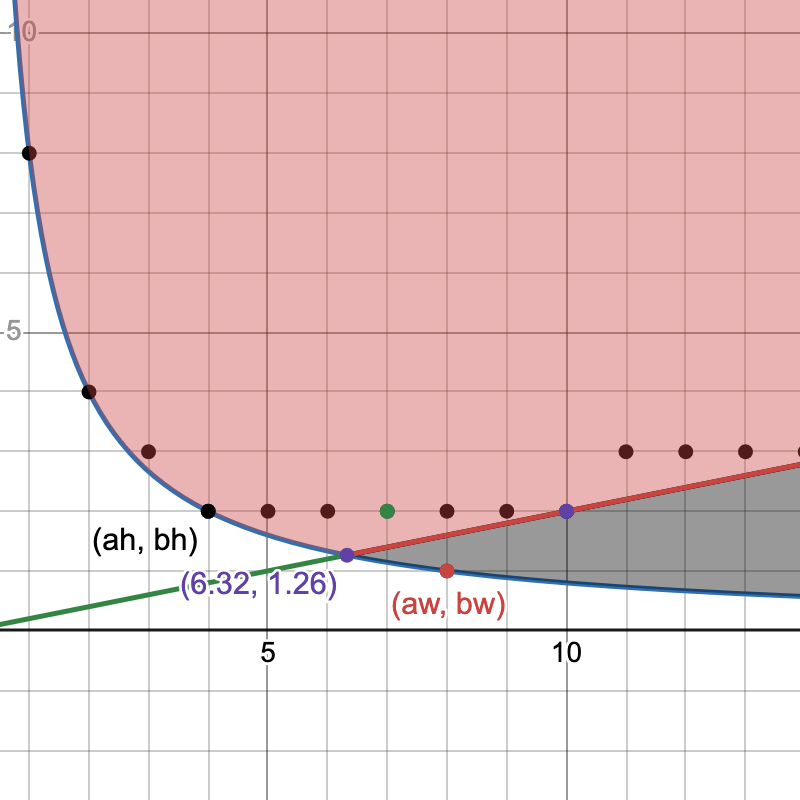
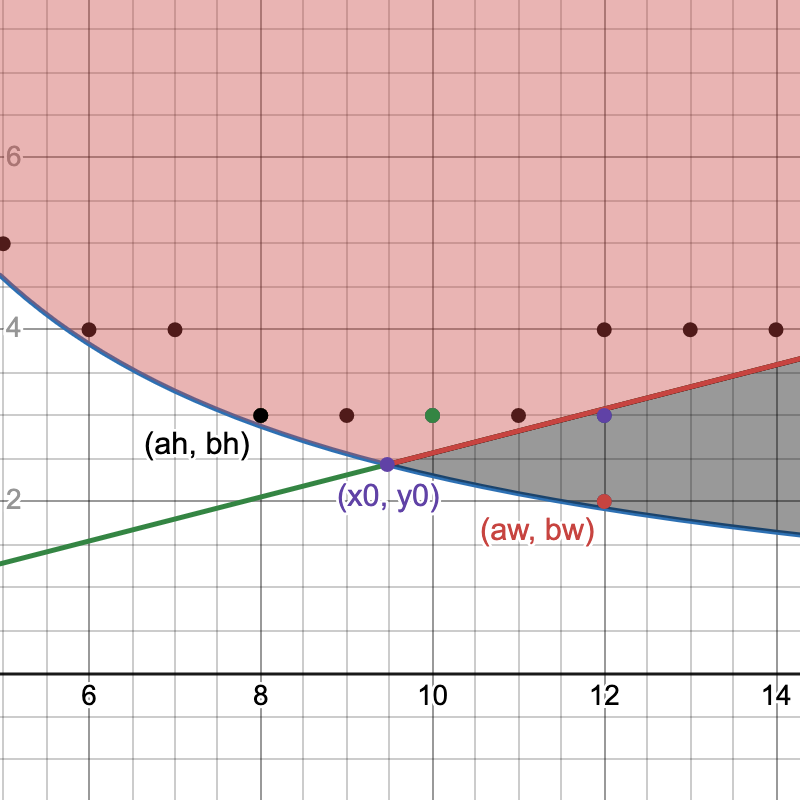
How do the fit‑width and fit‑height points compare in each of them?
Reveal second hint
Hint 2
By hint 1 a viable proof path is to show that if such a exists then one can find a point which is fit‑height.
Try to prove that if exists then specifically is fit‑height.
Reveal third hint
Hint 3
Attached are proof attempts from LLMs. They present various useful approaches but have subtle mistakes. Find these mistakes and use the proofs as inspiration for your own!
Proof 1
Courtesy of DeepSeek v4.
Setup
Let the fit‑width solution be
where
and
is the smallest integer satisfying
Its square side is
A valid fit‑width solution with the same and side length uses the same and any row count with
The algorithm picks the minimal
Claim
If
for every fit‑height solution, then there is no
with
In other words, the feasible interval for
collapses to a single value
Proof
Assume, for contradiction, that such a exists. Then so
Let Clearly
Now examine the fit‑height condition for row count
We know from Thus
From (1), so
Since because we obtain
Hence
i.e.,
satisfies the fit‑height condition.
The fit‑height algorithm will therefore find an optimal row count
Then
contradicting the strict optimality of the fit‑width solution.
Therefore, no such can exist when the fit‑width solution is strictly better than all fit‑height solutions. The pair is the unique grid achieving the maximal square side length.
Proof 2
Courtesy of QED‑Nano, a tiny 4B open‑source model developed exclusively for math proofs.
Proof.
Define for each
For a pair we have
Because are integers,
Hence iff
By definition therefore
Consequently for the fixed
Thus the set we are interested in is exactly the set of minimizers of
1. A useful auxiliary integer
Set
Then
so
Because
we have
therefore
From we obtain hence
Together and give
The hypothesis yields
2. Lower bound for
We prove that
Assume, to the contrary, that
Then
Because
is the minimum of
we have
Now
Since
we get
therefore the inequality
forces
The last inequality implies Adding gives
Let Because the integer cannot exceed the greatest integer hence Consequently
Moreover so
Thus
satisfies both conditions of
i.e.
But
contradicting the definition of
as the smallest second coordinate occurring in
Hence our assumption was false, and we must have
3. Determining and
From and we obtain together with this yields Therefore
Because of and we have together with and we get Hence
Finally and give while itself gives thus
4. Conclusion
For an integer b we have exactly when
By
and
the left‑hand side equals the right‑hand side and both equal
Because of (7) this common value is precisely b_w. Consequently no
other integer
can satisfy the inequalities, i.e.
Hence there is no with ∎
Proof 3
Another attempt from DeepSeek.
Proof
Assume the fit‑width solution is strictly optimal, meaning its square side is larger than the side of every fit‑height solution.
- Strict optimality forces (for the fit‑height solution is at least as good).
- The algorithm finds the smallest integer satisfying Hence Because is the smallest such integer, the gap is strictly less than 1.
- For we have At the same time Thus
- A different row count would still be a valid fit‑width solution with the same only if Hence no exists.
Why the converse (alternative grids) cannot happen under strict optimality
If a existed with then One can show this forces the existence of a fit‑height solution with side contradicting strict optimality. In practice, however, the simpler box argument above already forbids the existence of any such when
Reveal solution
My proof
Assume towards a contradiction there exists such that is a fit‑width point. Without loss of generality, we can further assume Using the definition of a fit‑width point and the minimality of we can write in terms of :
Suppose that Since we have by definition, and assumed and :
But so we’ve reached a contradiction. Therefore, together with the first result:
Choose any integer : the point is by definition fit‑height (real example in second graph from Hint 1). But then, since for this one fit‑height point :
In conclusion, contradicts thus can’t exist and is unique.
Thoughts on the LLMs’ performance
Using the prompt in a fresh conversation:
let r in [1, inf).
let n natural non‑zero.
let W = { (a,b) in N² | n <= ab and a >= rb }.
let H = { (a,b) in N² | n <= ab and rb >= a }.
let (a_w, b_w) = \argmin_{(a,b) in W} a.
let (a_h, b_h) = \argmin_{(a,b) in H} b.
assume a_w < rb_h.
prove that there exists no other b ≠ b_w such that (a_w, b) is in W.
All current frontier models managed to prove the statement correctly (don’t click on links if you didn’t solve yet):
- GPT 5.5 Pro had a correct, concise, minimal proof, light on algebra and easy to follow;
- Claude Opus 4.7 proved the same result as GPT 5.5 Pro but by more complex, slightly less readable means; a nice touch was providing the geometrical intuition for the proof, just as it is described in the main document;
- Gemini 3.1 Pro had an unintuitive roundabout excessively long but correct proof;
- DeepSeek v4 had a different yet equally elegant approach as GPT & Claude but the writing itself was hard to follow and full of redundant statements.
DeepSeek’s two failed proofs are part of a much greater conversation and used a more ambiguous prompt. It had a lot more context: the algorithm’s code, its complexity analysis, the graph representation, the terminology. This seems to have hurt its performance.
The prompt itself was built such that QED‑Nano managed to output a response. If any ambiguities were present it would “overthink” them and wouldn’t make meaningful progress beyond continuously reanalyzing the problem statement. Running QED‑Nano with smaller context (8k is all I could run locally), resulted in it forgetting about the initial problem and proving unrelated statements (e.g. that there are such that lol). I paid vast.ai 5$ to run it using the biggest supported context, which required ~46GB of VRAM.
That being said, QED‑Nano did prove the statement with a very minor push in a second prompt. The approach is equivalent to DeepSeek’s, with even more verbose writing. The cause for verbosity is not redundancy but derivations of intermediary results through alternative more inefficient methods.
I’ve also tried ChatGPT 5.5 Thinking Mini with the same prompt. After a failed proof which didn’t use the assumption and some subsequent corrective prompts, it concluded that:
As it stands, I cannot honestly provide a correct proof because the crucial implication needed for the contradiction is not derivable from the assumptions you gave.
Such hubris!